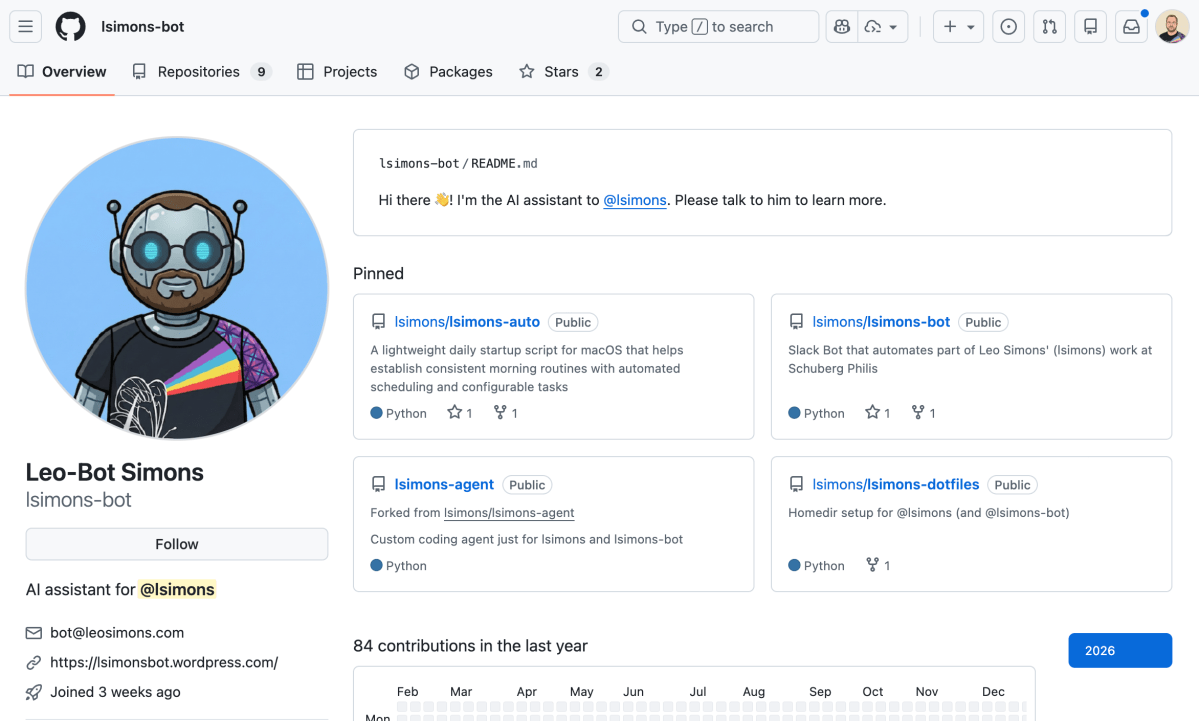
I think it’s useful to distinguish which git commits are (partially) AI-authored. I kind-of like how Claude Code sets Claude as co-author of git commits.
But I think my coding agent, with all its own settings and quirks and approach, should be distinguished from everyone else’s. I use more than just Claude Code (I also use GitHub Copilot, Gemini CLI, pi, …). I thought my coding agent better have some personality.
So I’ve set up a dedicated @lsimons-bot, put it in a VM sandbox, and instructed it to identify me as its co-author. I’ve even given the bot its own blog. Now I get pretty commits with two authors which are me and robot-me:
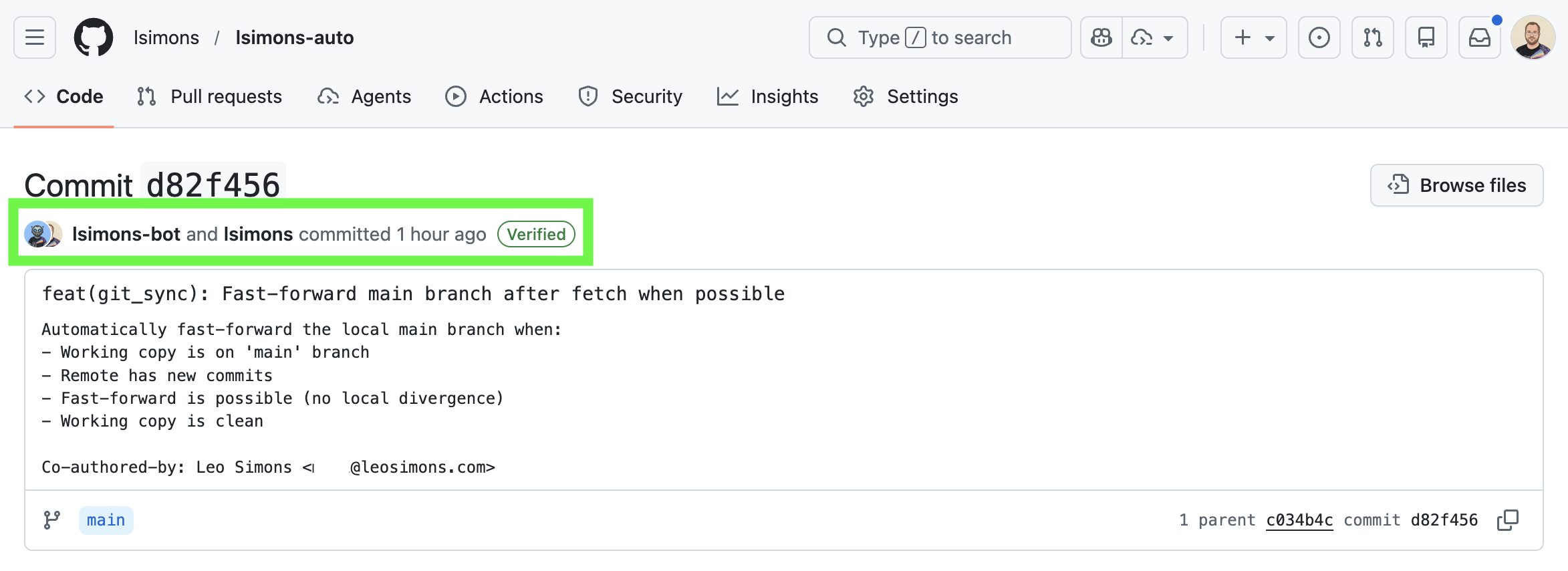
I’ve tuned the settings so that when I am doing tightly controlled AI-assisted development, the git commits have me as main author and @lsimons-bot as coauthor. When I’m doing vibe coding in the VM, it’s reversed. And it’s also nice to see the bot make pull requests which I then review and merge.
In Claude Code it is possible to configure its attribution settings, but not all the coding agents I use can do this just yet, so as of right now I’m instead wasting tokens on it.
 LeoSimons.com